Every site you launch needs updates, backups and small edits for as long as it is online. Most freelancers end up doing that work for free, by the hour when something breaks, or not at all. A care plan turns it into a fixed monthly fee. This guide covers what to include, how published plans are priced, three tiers you can adapt, how to pitch the plan at launch and how to bill it every month without thinking about it.
The short answer
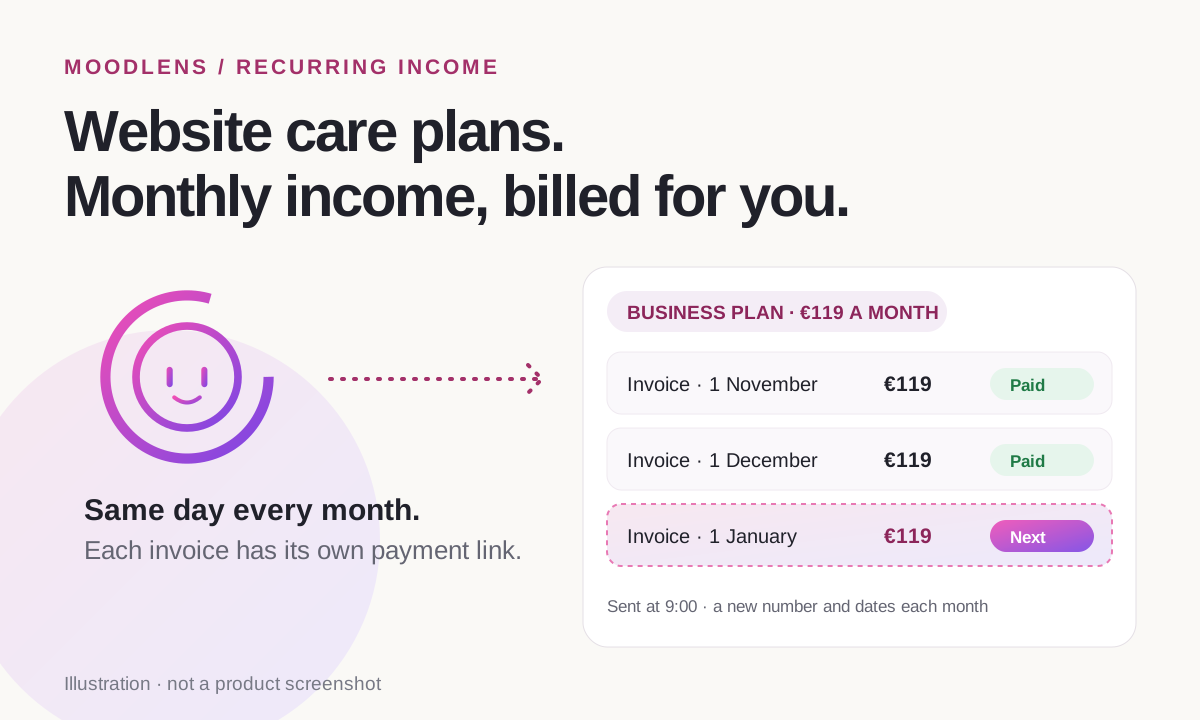
A website care plan is a fixed monthly fee for keeping a client’s site updated, backed up, secure and online, often with some edit time included. Published plans from maintenance companies cost about $89 to $359 a month, and UK freelance maintenance retainers typically run £50 to £150 a month. Offer two or three tiers, pitch the plan before launch, put it in a monthly agreement and invoice it on the same day every month. In MoodLens To-do, Plus and Pro can repeat an invoice monthly: each month MoodLens makes a copy with a new number and dates and emails it to your client at 9:00, with its own payment link.
From launch day to monthly income
- 1Offer the plan in the proposal
- 2Client picks a tier
- 3Sign a monthly agreement
- 4Send the first invoice
- 5Repeat it monthly
- 6Paid every month
Why a care plan beats fixing things by the hour
A launched website is not finished. The CMS, plugins and themes need updates, backups need to run, someone has to notice when the site goes down, and the client will keep asking for small changes.
Without a plan, that work arrives as emergencies. The client calls when something breaks, you fix it at a rate nobody agreed, and the invoice surprises both of you. A care plan makes the work predictable on both sides, and it gives you income that arrives every month, not only when a new project lands.
- Predictable income: ten clients on a €119 plan bring in €1,190 a month before you win a new project.
- Fewer emergencies: regular updates and backups catch problems before the client does.
- A reason to stay in touch: when the client needs a new page or a redesign, they ask you first.
What to include in a care plan
Clients do not buy “maintenance”. They buy the confidence that their site works, and a person to call. Write each part of the plan as something they can check.
- Software updates: CMS core, plugins and themes, at a set frequency, ideally tested on a copy of the site first.
- Backups: how often they run, how long they are kept and where they are stored.
- Security and uptime monitoring: what you watch, and how quickly you respond when the site goes down.
- Edit time: a set number of minutes or hours a month for small content changes, and whether unused time carries over.
- A short monthly report: what was updated, backed up and fixed.
- Hosting and the domain: either included in the plan or listed as the client’s responsibility.
- What is not included: new pages, redesigns, new features and third-party licence costs, which you quote separately.
How published care plans are priced
Maintenance companies publish their prices, which makes them a useful reference. They have support teams and round-the-clock monitoring, so a solo freelancer usually prices below them. UK freelancers sit lower: Expertsure’s October 2026 guide puts a freelance maintenance retainer at £50 to £150 a month.
The pattern matters more than the exact numbers. Plans come in tiers, and each tier adds more frequent updates and backups, closer monitoring and more edit time.
- In both published price lists, the middle plan costs about twice the entry plan, and the top plan two and a half to three and a half times as much.
- The difference between tiers is mostly update and backup frequency, monitoring and edit time, not the basic work.
| Provider | Entry plan | Middle plan | Top plan | Edit time |
|---|---|---|---|---|
| Websults (US, WordPress) | $99 | $199 | $349 | 30 minutes, 1 hour and 3 hours a month |
| WP Buffs (US, WordPress) | $89 | $179 | $239, or $359 for custom-coded sites | None on the entry plan, unlimited edits from the middle plan |
| UK freelance retainer (Expertsure) | £50–£150 | Not given | Not given | Ad hoc updates at £30–£60 an hour |
Three tiers you can adapt
The tiers below are an example for a freelancer looking after small business sites. Price yours from your time: if an Essential site takes about 30 minutes a month and your rate is €50 an hour, €59 covers that time and the backup and monitoring tools you pay for.
- Sell a minimum term, such as 6 or 12 months, or ask for a month’s notice to cancel.
- Say what happens to unused edit time. Plans often do not carry it over, because the fee also pays for your availability.
- Bill extra work at your normal rate, or as a separate quote approved before you start.
- Review prices once a year and give clients notice before a change.
| What is included | Essential | Business | Growth |
|---|---|---|---|
| Monthly price | €59 | €119 | €199 |
| Software updates | Monthly | Every two weeks | Weekly |
| Backups | Monthly, kept for 3 months | Weekly, kept for 3 months | Daily, kept for 30 days |
| Uptime monitoring | Included | Included, with alerts | Included, with alerts |
| Edit time | Quoted separately | 1 hour a month | 3 hours a month |
| Monthly report | Not included | Included | Included, with speed and SEO checks |
How to pitch the plan at launch
The best moment to offer a care plan is in the original website proposal, as an option that starts after launch. The client is already thinking about the site, and the plan is not a surprise. The second-best moment is the week before launch.
Keep the pitch short and concrete. Describe what you will do each month, not the technology.
- “Your site goes live on Friday. To keep it fast, secure and backed up, I offer a care plan from €59 a month. The Business plan also includes an hour of edits each month. Shall I start it from the launch date?”
- Explain the risk in plain words: a site that is never updated becomes slower and easier to break into.
- Show the middle tier first, with the smaller and larger tiers on either side.
- Say clearly who pays for hosting and the domain.
How MoodLens bills a care plan every month
Put the plan in writing first. Use a retainer contract with the monthly fee, the term and the notice period, and send it for signature. Your client signs from a secure link after verifying their email, without an account.
Then create the first invoice and choose Repeat monthly. Each month MoodLens makes a copy with a new number and dates and emails it to your client at 9:00 in your time zone, on the same day of the month. In shorter months it goes out on the last day. If the invoice is linked to a monthly contract, each one bills the next month and is checked against the signed amount.
Each invoice gets its own card payment link through your own connected Stripe account, or its own crypto link through NOWPayments. Without an online payment link, the payment details on the invoice are repeated. You can switch on payment reminders, which remind the client before and after the due date until the invoice is paid.
You decide how long it runs: stop after a set number of invoices, or keep going until you pause or stop it. Invoices already sent stay as they are, and missed months are skipped when you resume. If you prefer to check each invoice first, turn off automatic sending and each one waits in Drafts until you send it.
- Repeating invoices are included in Plus and Pro, not in the Free plan.
- Every invoice repeats the same items and amounts. Bill extra work on a separate invoice.
- Deposit, balance, milestone and hourly contract invoices cannot repeat.
- Payment reminders need a card or crypto payment link on the invoice.
- Payment providers charge their own fees, and an automatic invoice cannot guarantee that a client pays.
Billing a care plan by hand vs. a repeating invoice
| Category | MoodLens | Invoicing by hand |
|---|---|---|
| When the invoice goes out | The same day every month, at 9:00 | When you remember, often late |
| Number and dates | A new number and dates every month | Copied from last month and edited |
| How the client pays | Its own card or crypto payment link | Bank details the client has to copy |
| Chasing late payment | Optional reminders until it is paid | Your own follow-up emails |
| Pausing or ending the plan | Pause, resume or stop in one place | Remembering not to send it |
Frequently asked questions
How much should I charge for website maintenance?
Published plans from maintenance companies cost about $89 to $359 a month, and UK freelance maintenance retainers typically cost £50 to £150 a month (Expertsure, October 2026). Solo freelancers usually price below agencies. Work out your time per site each month, add the cost of your backup and monitoring tools, and offer two or three tiers.
What is the difference between a care plan and a retainer?
A care plan is a type of retainer focused on keeping a website healthy: updates, backups, security and small edits. A general retainer buys a block of your time for any kind of work. Many web designers sell both.
Should hosting be included in a care plan?
It can be. Including hosting makes the plan simpler for the client and gives you control of the server, but you become responsible for it. If you leave it out, say clearly that hosting and the domain are the client’s responsibility.
What happens to unused edit time?
Decide, and write it in the agreement. Plans often do not carry unused time into the next month, because the fee pays for your availability as well as the work. If you allow rollover, set a limit, such as one month.
Can MoodLens send the care plan invoice every month automatically?
Yes, on Plus and Pro. Choose Repeat monthly on an invoice and MoodLens makes a copy with a new number and dates each month and emails it to your client at 9:00, with its own card or crypto payment link. You can stop after a set number of invoices, pause it, or keep each one as a draft to check first.
Related MoodLens workflows
Sources and methodology
Prices come from the providers’ own pricing pages and a UK price guide, checked in October 2026. They are published list prices, not a survey, and they change. The tiers in this guide are an illustrative example. MoodLens features were checked against the product in October 2026.