A contract feels like a formality until the day a client pays late, cancels halfway through or asks who owns the files. This guide explains the clauses that protect your payment, gives you a free freelance contract template to copy, and shows how to get it signed online before any work starts.
The short answer
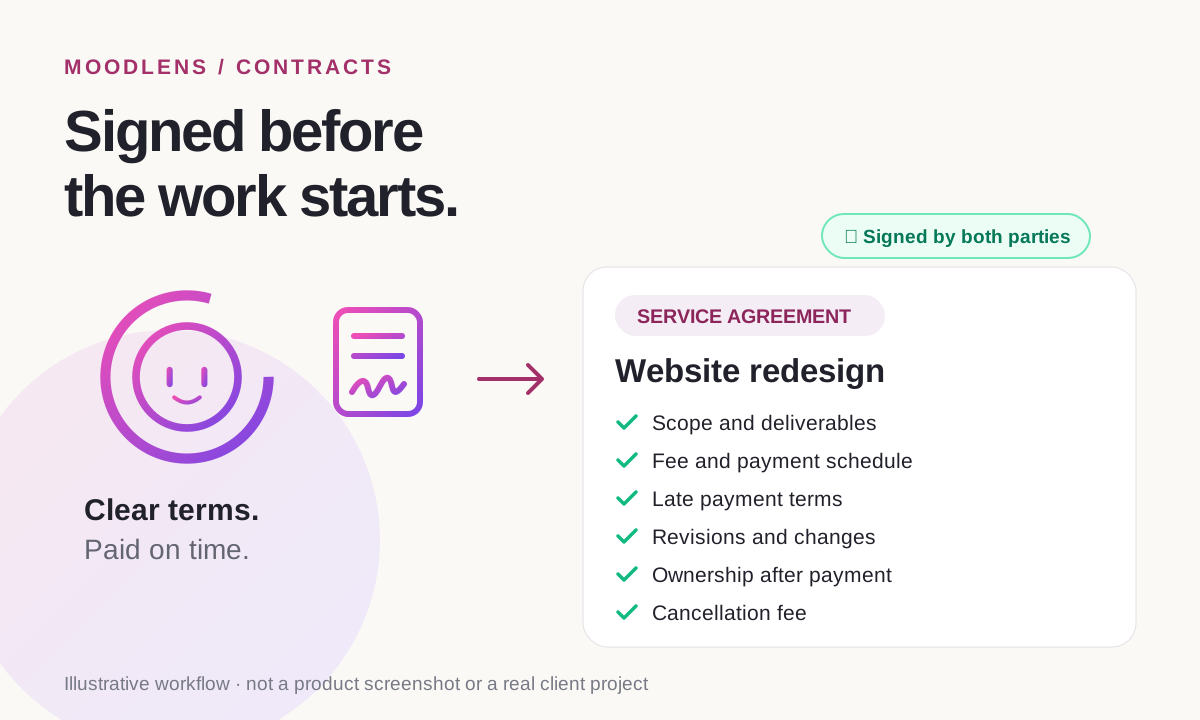
A freelance contract should name both parties, describe the work (or attach the scope of work), set the fee and the payment schedule, give a due date for invoices and say what happens when payment is late, limit revisions and explain how changes are priced, say when ownership of the work passes to the client, and cover cancellation, confidentiality, liability and which law applies. Get it signed before any work starts. In the EU and the US, a signature cannot be refused legal effect just because it is electronic, although some documents need stricter forms. In MoodLens To-do, an approved proposal can become the contract draft, your client signs online, and the final PDF is locked with an audit certificate.
From approved proposal to signed contract
- 1Name both parties
- 2Attach the scope
- 3Set the payment schedule
- 4Add late payment terms
- 5Agree ownership and cancellation
- 6Sign before you start
Why a contract matters, even with good clients
Most clients mean well. Contracts are not about distrust; they make sure both sides agree on the same things before money and time are on the line. Without one, a late payment, a cancelled project or a question about who owns the files turns into your word against theirs.
Many freelancers still work without one, and late or missing payment is common. The figures below are from different years and places, but they point the same way.
| Finding | Figure | Source |
|---|---|---|
| Freelancers who use a written contract for a given job | 28% | Freelancers Union, survey of about 5,000 freelancers, 2015 |
| New York freelancers who lost pay at least once because a client refused to pay | 62% | Authors Guild, Freelancers Union and other groups, 2022 |
| Of those, the share who lost more than $1,000 | 51% | Authors Guild and partners, 2022 |
| New York freelancers paid late at least once | 91% | Authors Guild and partners, 2022 |
In some places the law now requires a written contract. New York State, Illinois and California require one for freelance work above $800, $500 and $250 respectively. In the EU and the UK, late payment law gives you interest and compensation on business invoices even if your contract says nothing, but a contract makes your terms clear from the start.
The clauses that protect your payment
A good freelance contract is short and specific. These are the clauses that matter most when something goes wrong:
- Parties and start date: who the agreement is between, with full legal names and addresses.
- Scope: what you will deliver. Attach the approved proposal or a scope of work rather than rewriting it.
- Fee and payment schedule: the total, the currency, whether taxes are included and when each part is paid.
- Payment terms: when invoices are due, how they are paid and that work can pause if they are not.
- Late payment: interest or fees, within what the law allows where you work.
- Revisions and changes: how many rounds are included and how new requests are priced.
- Ownership: rights to the final work pass to the client once all fees are paid.
- Cancellation: notice, payment for work already done and a cancellation fee.
- Confidentiality, liability limits and which law applies if there is a dispute.
- Signatures from both sides, before the work starts.
Free freelance contract template
Copy the template below and replace every bracket. It is written in plain language for small service projects such as design, development, writing or consulting.
FREELANCE SERVICE AGREEMENT This agreement is between [your name or business, address] ("Provider") and [client name, company, address] ("Client"). It starts on [date]. 1. Services The Provider will deliver the work described in the attached scope of work or approved proposal dated [date]. Anything not described there is out of scope. 2. Fees and payment Total fee: [amount and currency], [plus VAT or other taxes, if they apply]. Payment schedule: [for example 50% before work starts and 50% on delivery]. Invoices are due within [number] days of the invoice date and are paid by [payment method]. 3. Late payment If an invoice is not paid on time, the Provider may charge [interest at (rate) / the statutory interest and compensation allowed by law] and may pause the work until the account is paid. 4. Revisions and changes [Number] revision rounds per deliverable are included. Further rounds and new requests are quoted in writing and start once the Client approves the quote. 5. Client responsibilities The Client provides [content, access, feedback] by [dates]. Delays in these move the timeline. 6. Ownership Ownership of the final deliverables passes to the Client once all fees are paid. The Provider keeps ownership of its pre-existing tools and materials and may show the work in its portfolio unless the Client objects in writing. 7. Cancellation Either party may end this agreement with [number] days' written notice. The Client pays for all work done up to that date, plus a cancellation fee of [amount or percentage] if work has already started. 8. Confidentiality Both parties keep each other's confidential information private, during and after this agreement. 9. Liability The Provider's total liability under this agreement is limited to the fees paid under it. 10. Governing law This agreement is governed by the laws of [country or state]. Disputes are handled by [the courts of / mediation in] [place]. Signed: [Provider name, date] · [Client name, date]
This template is a starting point, not legal advice. Contract and consumer law differ by country and state, especially for work with individuals rather than businesses. Have a lawyer review your standard contract once, and again for large or regulated projects.
Keep the scope out of the contract body. Attaching the approved proposal or scope of work means you change one document per project, not your whole contract.
Deposits and payment schedules that keep cash coming in
The payment schedule matters as much as the price. Splitting the fee means you are never too far ahead of what you have been paid.
- Start work only after the deposit arrives.
- Link ownership of the final files to full payment.
- Say that work may pause when an invoice is overdue, and that the timeline moves with it.
| Schedule | How it works | Good for |
|---|---|---|
| 50 / 50 | Half before work starts, half on delivery | Short projects with one main delivery |
| Milestones | For example 40% to start, 30% at a midpoint, 30% on delivery | Longer projects with clear stages |
| Monthly retainer | A fixed amount paid at the start of each month | Ongoing work such as support, content or marketing |
| Hourly, billed regularly | Hours invoiced every week or month, not at the end | Work that is hard to define upfront |
Is an electronic signature valid?
For most freelance agreements, yes. In the European Union, the eIDAS Regulation says an electronic signature cannot be denied legal effect or refused as evidence just because it is electronic. A qualified electronic signature has the same legal effect as a handwritten one. In the United States, the ESIGN Act gives electronic signatures and records the same legal weight as paper when both parties agree to sign electronically, and most states have adopted the Uniform Electronic Transactions Act.
What makes an electronic signature useful in a dispute is the evidence around it: who signed, how they were identified, when, and proof that the document has not changed since. Some documents, depending on the country, still need a handwritten or qualified signature, so check if your work falls into one of those categories.
Mistakes that make a contract useless
A contract only helps if it is clear, signed and easy to find. These are the most common ways it stops protecting you:
- Signing after the work has started, when you have already lost your leverage.
- A vague scope, so the contract cannot settle what “done” means.
- No due date for invoices, or no mention of what happens when they are late.
- Handing over ownership before the final payment.
- No cancellation terms, so a cancelled project leaves you unpaid for the work already done.
- Copying a template from another country without checking it against local law.
- Not keeping a signed copy both sides can find later.
How MoodLens handles contracts
MoodLens To-do keeps the contract with the client, the project and the invoices it leads to, so the terms you agreed are always next to the work.
Start from one of 32 built-in templates for common freelance services, from UI/UX design and web development to SEO, copywriting, video and consulting, plus a mutual NDA, or from a blank agreement. If you switched on the option on the proposal, approving it creates the contract draft with the agreed commercial terms for you to review. Your client opens the contract from a secure link, verifies their email, agrees to sign electronically and types, draws or uploads a signature, or declines. MoodLens records the time, the document hash and technical details of each signature, and once everyone has signed, the final PDF is locked with an audit certificate.
- Templates and contracts are not legal advice. Review them for your country or state.
- Contract sends per month depend on the plan: 3 on Free, 20 on Plus and unlimited on Pro.
- The contract draft created from a proposal still needs your review before you send it, especially the fee and payment terms.
A contract signed online vs. terms agreed by email
| Category | MoodLens | Agreed by email |
|---|---|---|
| What both sides agreed | One document with every clause | Spread across several messages |
| Proof of the signature | Consent, email verification, time and a document hash in an audit certificate | A reply saying “sounds good” |
| After signing | A locked final PDF for both sides | Easy to dispute what was meant |
| Payment terms | Written schedule, due date and late payment terms | Often missing until there is a problem |
| When the work starts | After both parties have signed | Whenever the client says “go” |
Frequently asked questions
Do I need a contract as a freelancer?
You do not always need one by law, but it is the clearest protection you have if a client pays late, cancels or disputes the scope. In some places, such as New York State, Illinois and California, the law requires a written contract for freelance work above a certain amount.
What should a freelance contract include?
The parties, the scope (or an attached scope of work), the fee and payment schedule, invoice due dates and late payment terms, revisions and how changes are priced, ownership of the work after payment, cancellation, confidentiality, liability and the governing law, plus signatures from both sides before the work starts.
How much deposit should a freelancer ask for?
Many freelancers ask for 30% to 50% before starting, or the first milestone in advance on longer projects. The right amount depends on the project, but asking for a first payment before work begins protects your time and confirms the client is committed.
Are electronic signatures legally valid?
For most freelance agreements, yes. In the EU, the eIDAS Regulation says an electronic signature cannot be denied legal effect just because it is electronic, and in the US the ESIGN Act gives electronic signatures the same weight as paper when both parties agree to sign electronically. Some documents still need stricter forms, so check your case. This is general information, not legal advice.
What is a kill fee or cancellation fee?
It is an amount the client pays if they cancel the project after work has started, on top of paying for the work already done. It compensates you for the time you reserved and turned other work down for.
Can my client sign a contract in MoodLens without an account?
Yes. Your client opens the contract from a secure link, verifies their email, agrees to sign electronically and signs. Once all parties have signed, the final PDF is locked with an audit certificate that records the signatures.
Related MoodLens workflows
Sources and methodology
Survey figures come from the Freelancers Union (2015) and from a 2022 survey of New York freelancers by the Authors Guild, the Freelancers Union and other creative organisations. Legal points are summarised from the eIDAS Regulation, the US ESIGN Act and state freelance laws, and are general information, not legal advice. MoodLens features were checked against the product in October 2026.
- Freelancers Union: why do only 28% of freelancers use a contract?
- Authors Guild: 62% of New York freelancers have lost wages to non-payment
- EUR-Lex: Regulation (EU) No 910/2014 (eIDAS), Article 25
- GovInfo: Electronic Signatures in Global and National Commerce Act (ESIGN)
- Mondaq: New York’s Freelance Isn’t Free Act
- Illinois Department of Labor: Freelance Worker Protection Act
- Hunton: California’s Freelance Worker Protection Act (SB 988)