A client asks “how much for a website?” and the honest answer is “it depends”, which is not something you can put on a quote. This guide gives you current market prices, three ways to set your own, a worked example priced from your hours and day rate, the parts of a quote that prevent arguments later, and how to ask for a deposit before you start.
The short answer
In the UK, freelance web designers typically charge £500 to £1,500 for a 3–5 page brochure site and £1,500 to £3,000 for a 5–10 page small business site with a CMS (Expertsure, October 2026). To set your own price, estimate the days each phase takes, multiply by a day rate that covers your costs, add a 15% buffer for feedback and revisions, and quote one fixed price with a written scope: pages, revision rounds, who supplies the content and what is not included. Ask for a deposit of 30% to 50% before you start. In MoodLens To-do, your client approves that quote from a secure link, then signs the contract and pays the deposit invoice, without creating an account.
From “how much for a website?” to a paid deposit
- 1Estimate the days
- 2Set a fixed price
- 3Write the scope
- 4Client approves online
- 5Contract is signed
- 6Deposit is paid
What web designers charge in 2026
There is no single market price for a website, but there are clear bands. The most detailed recent figures for freelancers come from Expertsure’s UK price guide, verified in October 2026. They are a useful anchor even outside the UK, because the order of the bands is the same everywhere: the more pages, custom features and integrations, the higher the price.
Treat these as typical ranges, not rules. Your location, your portfolio and the client’s budget all move the number, and a site with the same page count can cost twice as much if it needs custom functionality.
- UK freelance web designers charge about £25–£50 an hour at junior level, £40–£80 when experienced and £70–£120 as senior specialists (Expertsure, October 2026).
- WebFX, which sells web design itself, puts freelance website design at $500 to $10,000+ and agency design at $3,000 to $30,000+, based on what more than 2,000 businesses told it they spend.
- Scope moves the price more than page count: custom features, copywriting, integrations and the number of people who must approve the work.
| Type of website | Typical scope | Typical price |
|---|---|---|
| Brochure site | 3–5 pages | £500–£1,500 |
| Small business site | 5–10 pages, custom design, CMS and blog | £1,500–£3,000 |
| Larger business site | 10–20 pages with a CMS | £2,000–£5,000 |
| Online shop | E-commerce | £3,000–£10,000 |
| Complex custom build | 20+ pages and custom features | £10,000–£50,000+ |
Three ways to price a website
Most freelance web designers end up quoting a fixed price. Clients prefer it because they know the total before they commit, and you keep the benefit when you work faster. It only works when the scope is written down, so that anything outside it has its own price.
Packages are fixed prices with the scope already decided, such as a starter site, a business site and an online shop. They save you from pricing every project from scratch, and offering two or three lets the client choose how to go ahead rather than whether to.
| Method | How it works | Works best when | Watch out for |
|---|---|---|---|
| Hourly | You bill the hours you work at an agreed rate | The scope is unclear, or for fixes on someone else’s site | Clients fear an open-ended bill, and you earn less as you get faster |
| Fixed price | One price for a written scope | You can list the pages, features and revision rounds | Scope creep, unless extra work has its own price |
| Packages | Two or three fixed-price options with different scope | You build similar sites again and again | Packages too vague for the client to compare |
Work out your price from your own numbers
Market ranges tell you whether a price is reasonable. They do not tell you whether it pays you. For that, start from your own time and rate.
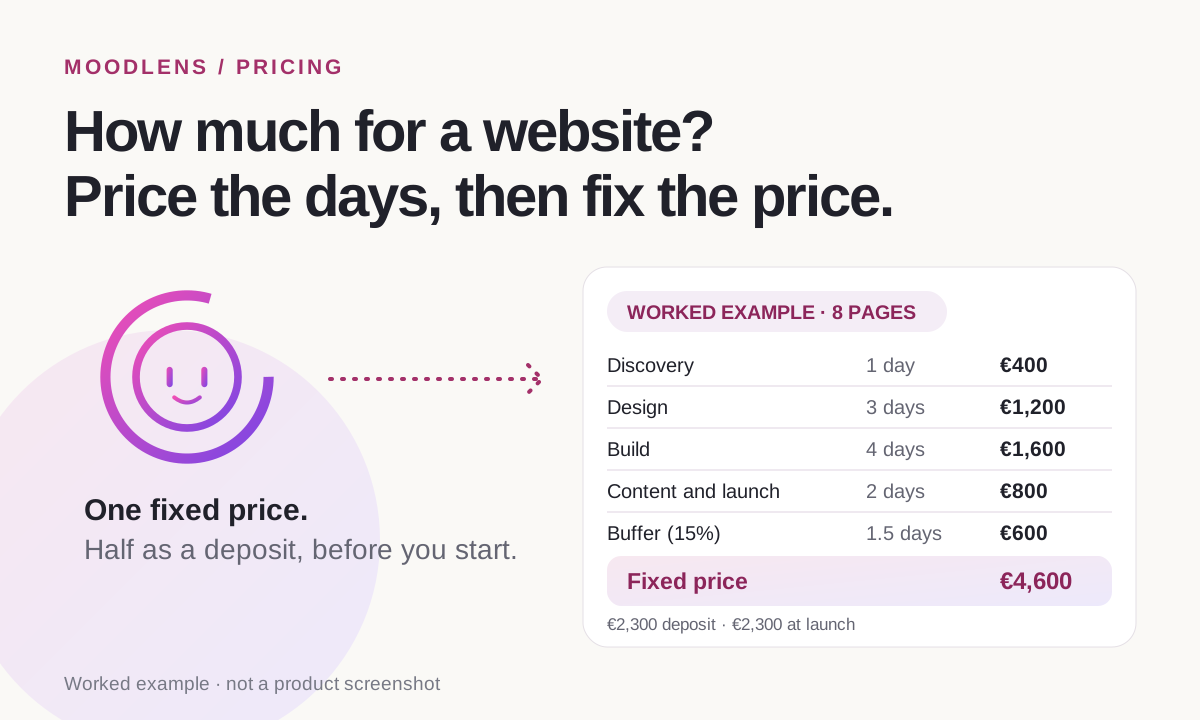
In the example below, an 8-page small business site takes ten working days at a day rate of €400, plus a 15% buffer for feedback, revisions and project management. That gives a fixed price of €4,600, split into a €2,300 deposit and €2,300 at launch.
- Set a day rate that covers a year of costs (software, equipment, insurance, taxes, pension and the income you want) divided by the days you can actually bill. Sales, admin, holidays and sick days all come out of the year.
- Estimate each phase in days: discovery, design, build, content and launch. Use your last similar project, not your best one.
- Add a buffer, for example 15%, for feedback rounds, calls and project management. They are real work and easy to forget.
- Compare the result with the market ranges. Far below them, you are probably underpricing; far above, reduce the scope or explain what the client gets for it.
- Round to one clean fixed price and decide the payment schedule before you send anything.
| Phase | Days | Price |
|---|---|---|
| Discovery and sitemap | 1 | €400 |
| Design: home page and two templates | 3 | €1,200 |
| Build: 8 pages, CMS and contact form | 4 | €1,600 |
| Content entry, testing and launch | 2 | €800 |
| Buffer for feedback and revisions (15%) | 1.5 | €600 |
| Fixed price | 11.5 | €4,600 |
What to put in the quote
A website quote is mostly a list of decisions. Every decision you leave open becomes a discussion later, usually when the work is half done and the budget is spent.
Keep the price and the payment schedule next to each other, near the top. Clients read the price first, so make the rest of the page explain it.
- The goal of the site in one or two sentences, in the client’s words.
- The pages and features, listed one by one: for example home, about, three service pages, contact and a blog, built on a CMS the client can edit.
- The revision rounds included, for example two on the design and one on the build.
- Who supplies what, and by when: copy, photos, logo, domain and hosting access. Missing content is a common reason website projects stall.
- What is not included: copywriting, photography, paid plugins, hosting and maintenance after launch.
- The price, the payment schedule and how extra work is priced: your day rate, or a short separate quote approved before you start.
- How long the offer is valid, for example 14 days.
Ask for a deposit, and price extras before you do them
Many freelancers ask for 30% to 50% before work starts and the balance at launch. For projects longer than a few weeks, split the rest into milestones, such as design approved and site launched, so that no single late invoice covers most of the project.
The other half of getting paid is extra work. When the client asks for one more page halfway through, do not say yes in chat. Answer with a price and get it approved first. A short, friendly reply is enough.
- “Happy to add the events page. It is outside the original scope, so here is a quick quote: €400, about a day of work. Approve it and I will add it to this week’s plan.”
- Do not start until the deposit is paid. It confirms the client is serious and pays for your first weeks of work.
- Write the schedule in the quote and again in the contract, with real dates or clear triggers such as “on launch”.
How MoodLens turns the quote into a signed, paid project
MoodLens To-do keeps the quote, the contract and the invoices next to the website project, so the scope and the price you agree are the ones everything else starts from.
Write the quote as a proposal, or let MoodLens draft it from your project or a spoken brief, then check the scope and the price before you send it. Your client opens it from a secure link, verifies their email with a one-time code and approves it without creating an account. MoodLens records who approved it and when, against a fixed snapshot of the version they reviewed.
If you switch on the option before sending, the approval also creates a contract draft with the agreed terms. Once every required signer has signed, you can create a prefilled deposit invoice from the contract, and later the balance or milestone invoices. Clients pay by card through your own connected Stripe account or in cryptocurrency through NOWPayments, also without an account.
When the client asks for something extra, send it as a new proposal in the same way, so it is approved and priced before anyone does the work.
- Approving a proposal is not a signature. Use the contract for the legal terms.
- MoodLens does not price the website for you. Check every AI-drafted scope and price before you send it.
- The Free plan includes 3 proposal sends a month.
- Payment providers charge their own processing fees.
A quote sent by email vs. a proposal the client approves online
| Category | MoodLens | Quote in an email or PDF |
|---|---|---|
| Where the scope lives | In the approved proposal, next to the project | In an attachment, a thread or someone’s memory |
| How the client says yes | Approves from a secure link after a one-time email code | A “looks good!” reply |
| Proof of what was agreed | Who approved it, when, and a snapshot of that exact version | Whichever version of the PDF you can find |
| What happens after yes | A contract draft with the agreed terms, then a deposit invoice | Copying the numbers into a contract and an invoice by hand |
| Extra work mid-project | A new proposal, approved before the work starts | Agreed in chat and often never billed |
Frequently asked questions
How much should I charge for a 5-page website?
In the UK, a 3–5 page brochure site typically costs £500 to £1,500 from a freelancer, according to Expertsure’s October 2026 price guide. Your own price should come from your days and your day rate: estimate each phase, add a buffer of about 15% for feedback and revisions, and check the total against that range.
Should I charge hourly or a fixed price for a website?
For most website projects, a fixed price with a written scope works better: the client knows the total, and you are not penalised for working fast. Charge hourly when the scope is unclear, such as fixes on someone else’s site, and use your rate to price extra work outside the agreed scope.
How much deposit should I ask for a website?
Many freelancers ask for 30% to 50% before work starts, then the balance at launch, or in milestones for longer projects. Put the schedule in the quote and in the contract, and do not start until the deposit is paid.
What should a website quote include?
The goal of the site, the pages and features, the revision rounds, who supplies the content and by when, what is not included, the price, the payment schedule, how extra work is priced and how long the offer is valid.
Can my client approve the quote without creating an account?
Yes. In MoodLens To-do, your client opens the proposal from a secure link, verifies their email with a one-time code and approves it without an account. They can sign the contract and pay the deposit invoice the same way.
Related MoodLens workflows
Sources and methodology
Market prices come from the guides linked below and are dated. They are estimates, not a survey of every market: Expertsure covers UK freelancers, and WebFX sells web design itself. The worked example is illustrative. MoodLens features were checked against the product in October 2026.